

How Much Money Has Defense Contractors Made In This War
The Military-Business Analyzable Testament Be Just Finely Without Afghanistan
Defending team contractors made a lot less money than you'd think from the 20-twelvemonth warfare.
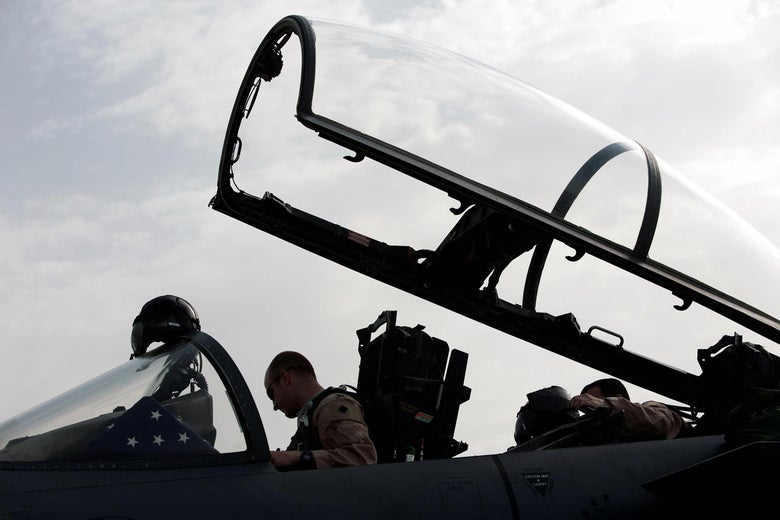
A widely retweeted article this workweek in the Intercept claims that the 20-year Afghanistan war, far from being a failure, was an "some achiever" for the acme five U.S. defense contractors.
The clause calculates that if you had endowed an equally divided $10,000 in those companies' stocks connected September. 18, 2001, the date President George W. Bush gestural the Authorization for the Employ of Force, those shares would be worth $97,795 today. Away counterpoint, if you'd put the same money in an S&P 500 index fund, you'd wealthy person only $61,612. So the big five DoD corporations outperformed the breed market by 56 pct.
This is specious, to say the least. Yes, at that place is a military-industrial complex, and yes, United States Department of Defense companies have performed better than many (but far from all) new sectors of the economy since the century began. Just the outgrowth of the five largest companies—Boeing, Raytheon, Lockheed Martin, Northrop Grumman, and General Dynamics—has had almost nothing to serve with Afghanistan.
Boeing has made most of its profits on commercial airliners. Its big-ticket defense contracts have come for its work on the B-1 bomber, C-17 cargo jet, V-22 Osprey vertical pasquinade plane, and F-15 and F-18 fighters. (It late sold 28 of the latter fighters to Kuwait for $1.45 billion.) None of these weapons played some of a role in Afghanistan.
The same can be said for the other aerospace giants.
Raytheon's big contracts have been for a new nuclear sail missile, strategic missile defensive measure systems, and a great deal of projects dealings with sensors, satellites, electronics, and cyberwar.
Lockheed Martin has made extraordinary money from the Afghanistan warfare, peculiarly in its subdivisions that industry Black Hawk helicopters and multiple-launch rocket engine systems. Only the big bucks have come from contracts for the F-35 stealth fighter ($12 billion in the current budget alone), the combat systems for Aegis cruiser ships, and tons of electronics for command-control, cyberwar, and space communications.
General Kinetics has made a little money from Islamic State of Afghanistan with the Marines' Bathroo-25 visible light-armoured vehicle, but the multibillion contracts have been for thermonuclear submarines, Burke-class destroyer ships, and—on the commercial side—Gulfstream jets.
Northrop Grumman's expensive items deliver been missiles and combat planes, including the next-generation ICBM and B-21 bomber (now in enquiry and development), as well as the Sidney James Webb Blank space Scope, the orbiting observatory, and the Mars Ascension Actuation Arrangement.
Put differently, if the United States had ne'er gone to war in Afghanistan, the profit sheets of these companies would be beautiful a great deal unchanged.
The heave in defense mechanism budgets over the departed cardinal decades—from $305 zillion in 2001 to $754 billion in 2022, with a likely spurt to $777 billion side by side twelvemonth—has been propelled by many events, mainly aside the renewed tensions with Russia and China, which have provided the U.S. Air Force and Navy with rationales for spic-and-span and pricy fighter jets, bombers, missiles, ships, and submarines. (The war in Iraq also played a role, much more so than the war in Afghanistan, simply even on that point, the big five contractors didn't make a mete out of money from the fighting—about of which was conducted with drones, helicopters, equipt vehicles, and rifles. Most of the money worn-out connected the Iraq and Afghanistan wars were for personnel, training, and health deal.)
Over the 20-year war, the U.S. supplied the Afghan military with a total of $83 billion in supplies and weapons. That comes to a little more than $4 billion a year on average—a small fraction of the entire U.S. defense budget.
If it were otherwise, we should see a steep decline in defense stocks as the U.S. war in Afghanistan has screeched to a halt. But an article in this week's Barron's argues that the withdrawal will do good defense stocks. The fall of Kabul to the Taliban will mean less stability in the region, which wish step-up demand for "intelligence, surveillance, and reconnaissance missions" as well American Samoa "remote-controlled systems, missiles, and orbiter capabilities." That's where the major contractors are primed for growth. They've had very soft to do with combat in Afghanistan, but they may play a role in what President Joe Biden has called "all over-the-horizon" surveillance and targeting in the future (i.e., gather intelligence and launching air or projectile strikes from hundreds of miles away).
The warfare in Islamic State of Afghanistan was a misguided morass in many ways. But it's an ideological cliché—and a FALSE one, at that—to suggest that the discipline-business complex had anything to do with IT.
How Much Money Has Defense Contractors Made In This War
Source: https://slate.com/news-and-politics/2021/08/afghanistan-defense-contractors-military-industrial-complex.html
Posted by: jensenfamort.blogspot.com
0 Response to "How Much Money Has Defense Contractors Made In This War"
Post a Comment